

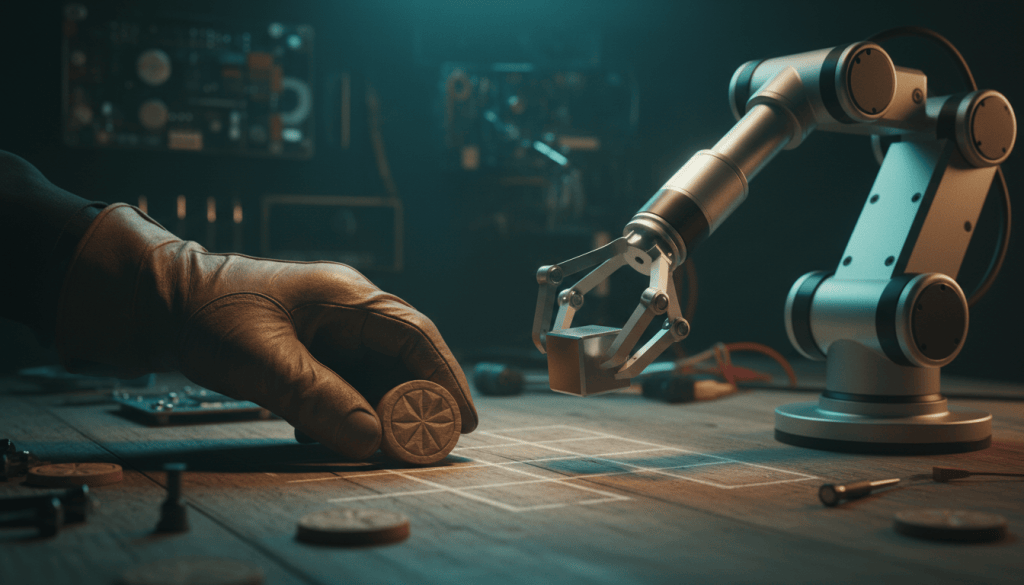
It’s time to dust off the robot arm. If you’ve been following along, you’ll know I built the 6DOF Programmable Robot Arm Kit from IDY Production, then spent a fair while getting it to actually work. My next project is to have that arm play tic-tac-toe against me, physically picking up and placing its own pieces on a real board.
The goal
Simple to say, harder to do. I want to sit down at the bench, make my move, and have the arm work out its reply and place its piece in the right square. No screen, no app. Just me, a board and an arm that (hopefully) doesn’t knock everything onto the floor.
Where I’m starting from
The arm has six servos, aluminium plates and a gripper, driven by a Keyestudio UNO R3 board. I learned early that the board can’t power a bank of servos, so they run from my bench top power supply, and I tidied the wiring with a Keyestudio sensor shield. Last time I got it doing a repeating pick-and-place routine, one servo at a time, and then moved on to multi-motor movement, which sent me down the rabbit hole of kinematics. Tic-tac-toe is a good excuse to finally climb back out of that hole with something working.
Why it’s an interesting challenge
Tic-tac-toe is a trivial game for a computer. Everything around it isn’t. Here’s what I think makes it worth doing:
- Knowing the board. The arm needs to know where I’ve played. That could start as me typing my move in, but the real goal is for it to sense the board itself.
- Game logic. The game is small enough to solve completely, so the arm should never lose. Whether I write a classic algorithm or experiment with an AI model to choose moves is part of the fun.
- Pick-and-place accuracy. Nine squares, each only a few centimetres wide. The piece has to land in the middle of the right one, not halfway into the next.
- Calibration. Hobby servos aren’t precise, and small errors at the shoulder become big errors at the gripper. I’ll need a repeatable way to map squares to arm positions.
- Vision. Possibly a camera to read the board. I finally had success with the Arducam, so that’s an obvious candidate, though I’m not committing yet.
The rough plan
- Fixed positions first. Build a board and a piece supply in fixed spots, then record the servo angles for each of the nine squares and the pick-up point.
- Reliable pick and place. Get the arm to move any piece to any square, smoothly and repeatably, using the multi-motor movement I already have.
- Add the brain. Write the game logic so the arm can play a full game with me entering my moves manually.
- Close the loop. Add sensing, ideally a camera, so the arm can see my move without any help.
- Revisit kinematics. If time allows, swap recorded positions for inverse kinematics so the board can move without recalibrating everything.
No doubt each step will take longer than I think. That’s been the pattern with every project here so far.
What I’ll share
As always, I’ll post the wins and the failures as I go: wiring changes, calibration tricks, videos of the arm in action and my code on GitHub alongside the earlier routines. If you’ve built something similar, or have tips on cheap board sensing, let me know. Stay tuned.

