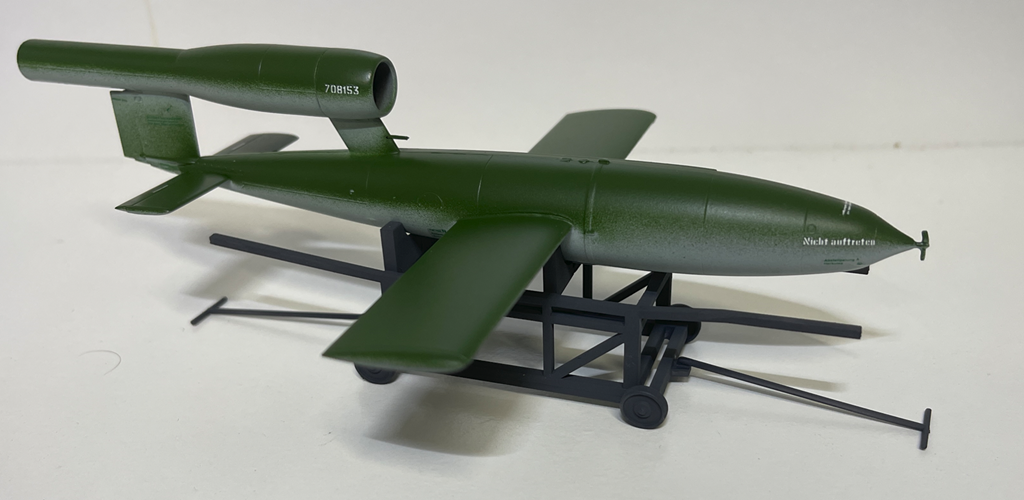
Tamiya V-1 Fieseler Fi103 Flying Bomb Scaled Plastic Model Kit
The challenges of 3D printing
I’ve been working on a phone holder for a car that sits in a cup holder. The reason for this is that I don’t like things blocking my view when I’m driving. Thus, I want to ‘move’ the phone away from the windscreen and down towards the centre console.
Rather than completely re-inventing the wheel here, I decided to use a motorcycle mount from Quadlock to actually hold the phone. The other end needed to grip onto something like a tube.
The starting point for mounting the Quadlock was to create something that would sit in the cup holder and then attach to the Quadlock. Creating a solution to do that is easy enough, but the challenge comes when trying to print that.
Why? Because, basically you can’t print in thin air. You need each layer of the print to be supported but something underneath it. This means you have to think carefully about your design.
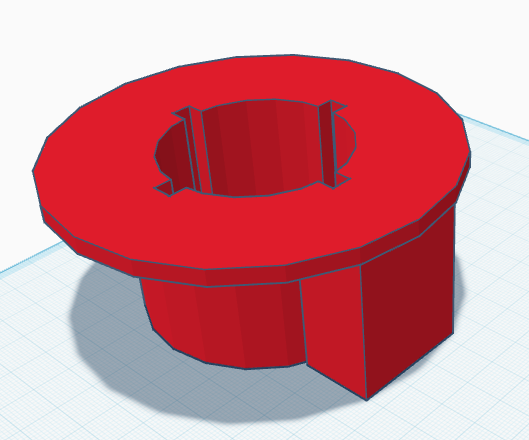
What I ended up doing was splitting the mount into two parts. The first part, as you see above, fits inside the cupholder in the car. That means basically using a cylinder design. However, to stop this rotating in car’s cupholder I added a key since the cupholder has a bridge to another holder nearby.
I then put a table top onto the cylinder to stop the structure tipping side to side and potentially jumping out of the holder in the car. This is where I had to start thinking about how I was going to print this because, in the long run, there would need to be a structure on the top of the table to connect to the Quadlock, but if I made it a single object to print I’d have trouble printing it as much of it wouldn’t have support during printing.
So, I broke the holder in two pieces, the insert with the table top (above), that I could flip and easily print and have everything supported and then an insert (below) to hold the Quadlock and slide inside the holder.
If I had tried to print these tow items as a combined object I would have struggled. But breaking them into two separate interlocking parts allows both to have full support when printed.
You will also notice that I added four key slots for the insert to prevent it from rotating when in the printed holder. The Quadlock then securely fastens to the cylinder at the top of the insert.
The end result looks like the above and works well. The tabletop of the holder also prevents the Quadlock from scratching the trim if it does move around when the car is travelling. It also takes some weight off the cylinder that mounts the Quadlock as well reducing the chance of it snapping when the car is in motion as the phone bounces around.
The key is that, not only do you need to design an object to solve your problem but you need to work out a way to print it using a 3D printer that can’t print on just thin air!
Kawada Nanoblock Nagoya Castle NBH_207
Configuring an Arducam Mega 3MP
The next step in my plans was to add vision to my environment. For this I selected the Arducam Mega 3MP camera, which seemed to be straight forward enough from the initial research that I did. That has turned out to be significantly wrong.
I started off with trying to connect the camera to the ESP32 S2 Wroom but that was an abject failure. I then decided to move back to the Adafruit Huzzah ESP8266 to eliminate challenges with the ESP-32 S2 Wroom. Even this has proved challenging. Here’s what I have achieved so far.
The first challenge is to understand the SPI interface, which I haven’t dealt with before. You can read more about the SPI interface here:
https://docs.arduino.cc/learn/communication/spi/
and here:
https://learn.sparkfun.com/tutorials/serial-peripheral-interface-spi/all
but according to the docs:
Serial Peripheral Interface (SPI) is a synchronous serial data protocol used by microcontrollers for communicating with one or more peripheral devices quickly over short distances.
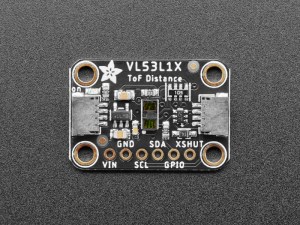
In essence, I needed to correct connect the Arducam Mega 3MP camera SPI interface to the Adafruit Huzzah ESP8266 SPI interface. The Arducam Mega 3MP camera pinouts look like:

and this is how I connected it to the Adafruit Huzzah ESP8266
1. CS (Chip Select) -> GPIO16 (or any available GPIO pin) (D4)
2. MOSI -> GPIO13 (D7)
3. MISO -> GPIO12 (D6)
4. SCK -> GPIO14 (D5)
5. GND -> GND
6. 3.3V –> 3V

VCC (3.3V) and GND for the camera I have taken from an external power supply source.
With all that now wired up, the other trick is that you need to have something to receive and display the image from the camera. All the demos I saw pointed to a Arducam GUI tool:
https://www.arducam.com/docs/arducam-mega/arducam-mega-getting-started/packs/GuiTool.html
or direct download:
https://github.com/ArduCAM/Arducam_Mega/releases/download/v2.0.1/ArducamMegaSetup_Windows_x64.exe
which you install on your PC and view the camera via the USB cable

However, I had no real luck getting this to work at all with the example code provided. Therefore I returned to first principles.
I used this code:
https://github.com/directorcia/ciaopslabs/blob/main/Projects/15/ov3640-capture.cpp
to capture an image which seemed to work without any issues when I looked at the terminal messages and execution. Problem was, I could now capture an image but I couldn’t see it! I needed to send the image somewhere to view it. Rather than use the Windows app I thought I’d send it to an adafruit.io dashboard.
Once I had set up a dedicated feed in adafruit.io and a dashboard with an image widget I used this code:
https://github.com/directorcia/ciaopslabs/blob/main/Projects/15/ov3640-upload-v1.cpp
to try and send it. Unfortunately, I could see the code was executing and uploading to adafruit.io but I was getting feed errors. Some data had indeed appeared in the feed but an image wasn’t displaying. I also found that the Adafruit Huzzah ESP8266 was getting some sort of major error causing it to reset regularly.
After some investigation, it was recommended to disable the history on an adafruit.io feed to allow for greater data transfer sizes. The documentation tells me:
While history is turned ON, feed data is limited to 1KB (1024 bytes) in size.
While history is turned OFF, feed data is limited to 100KB (102400 bytes) in size

To do this go into the adafruit.io Feed and select the COG next to the Feed History heading as shown above. In the dialog that appears set the history to OFF as shown.
The other thing that I noted was:

The uploaded images appear to need to be base64 encoded.
I have some new code to try and overcome all of these issues which I’ll now go and try.
Controller upgrade
I’ve decided to upgrade the remote controller for the robot. Adafuit.io has the above component you can add to your dashboard. This provides a lot more commands than the original
![]()
one that I have been using as can be seen above.
My plan now is to add a pan and tilt camera to the robot so it can ‘see’. I’m also working on creating some additional parts for the robot to hold the 6V batter case as well as make the front platform more accessible. I’ll basically place it above the 6V battery which will sit over the front wheels.
I am also working on a way to better secure the bread board onto the robot rather than using a bulldog clip. It is all getting rather crowded up there, so creating some more space will be good.
It seems like the camera interfaces to the ESP32S2 Wroom using a set of SPI connectors which are:
which I found here:
https://docs.arducam.com/Arduino-SPI-camera/MEGA-SPI/MEGA-Quick-Start-Guide/
most of which I can see on the board:
The one that is missing is CS = 7. I found this after some hunting:
pin 7 on the ESP32-S2 Thing Plus WROOM is the IO4 pin
I am not sure whether it os true but I’ll try:
GPIO04 on the other side of the chip as shown above as the pin for CS.
I bought this camera:
https://core-electronics.com.au/arducam-mega-3mp-camera.html

which has pinouts:
Once I get it all connected then I need to write to code to capture images. There are lots of examples of doing that with an app on your desktop but I want the camera to capture an image and send it up to adafuit.io which it seems I can do. No sure of exactly how just yet, but first step is getting the camera hooked up and being able to view the images it captures.
Robot with distance
As I detailed in a previous post:
I had my robot moving and taking commands from an Internet based dashboard. The missing piece was to get the distance sensor operational, which I have now achieved.
I firstly need to print a mount to allow the distance sensor to be mounted to the buggy frame. I have uploaded that to the CIAOPSLabs repo here:
https://github.com/directorcia/ciaopslabs/blob/main/3dprint/mounts/VL53L0X-distance.stl
With the VL53L0X sensor now mounted and connected to the processor the layout now looked like the above image.
Basically, the motor controller, distance sensor and LCD display all communicate with the ESP32-S2 processor via the SDA/SCL bus. They achieve this by all being on a different address.
It was also important to ensure that I connected up the wheel in a know sequence because to drive the mecanum motion I needed to turn different wheels to make it move in certain directions per:
I’ve uploaded the initial code with it all working here:
https://github.com/directorcia/ciaopslabs/blob/main/Projects/14/moveanddistance-v1.c
The commands on the keyboard are:
1 = Left forward 45
2 = Forward
3 = Right forward 45
4 = Left 90
5 = Stop/Start
6 = Right 90
7 = Left back 45
8 = Back
9 = Right back 45
* = Slower
0 = Spin on the spot
# = Faster
As the robot moves it displays the distance on the LCD display like so:
The robot starts with speed = 0 (i.e. stationery). You press 5 to set the speed to 100 but it will not yet move until you give it a direction. If you now press 2, the robot will move forward at a speed of 100. You can then happy go along changing directions via the keypad. If you press 5 again, the robot will stop moving.
With all this now working, the next update will be for the robot to use the distance sensor to determine how far away it is from object (at the front), slow and stop if necessary to avoid hitting these objects.
I want to also optimise the code to make it more responsive if I can and I’ll post the updates here and to the CIAOPSLabs repo when I get it all working.
Beyond that I’m still trying to decide what to get the robot to do? If you have any suggestions, let me know but I’m kind of thinking that the robot needs to have ‘vision’ next!
Gridfinity print times update
I’ve been back printing more Gridfinity containers on my Snapmaker Artisan and have updated the times taken above.
DFRobot 1602 LCD display mount
Part of recent Mecanum motion project required me to design and print a frame for the DFRobot 1602 LCD display as shown above. It is basically a right angle bracket that allows it to be mounted onto the frame.
I’ve uploaded the STL model to:
https://github.com/directorcia/ciaopslabs/blob/main/3dprint/mounts/DFRobot-1602-LCD-disp.stl
so you can grab a copy and print it out for yourself. If you don’t have access to a 3D printer then send me a donation via:
to cover the postage at least and I’ll send you a print.
Paint mixer
One the problems I’ve recently solved with 3D printing was to create a simple paint mixer (shown above).
Basically it is a block with a few divots in it. This allows you to easily a small amount of paint in each divot. The advantage over a flat area is that the mixing process doesn’t spread the paint too broadly. This solved a problem for me when I am building my plastic models and need a small amount of colours mixed together.
The dimensions of the mixer are:
76.8 mm long
19 mm wide
4.8 mm deep
I’ve uploaded the STL model here:
https://github.com/directorcia/ciaopslabs/blob/main/3dprint/tools/Paintmixer.stl
so you can grab a copy and print it out for yourself. If you don’t have access to a 3D printer then send me a donation via:
to cover the postage at least and I’ll send you a print.
Mecanum motion
https://www.youtube.com/watch?v=9vtnGbYjG7k
Happy to say that my robot frame is now able to move around as seen in the above video. I’ll post more details up soon once I make some small improvements but stoked to have it all working and controlled from my phone!